
The Coyote Song: A Lesson in Gopher Holes and Blame
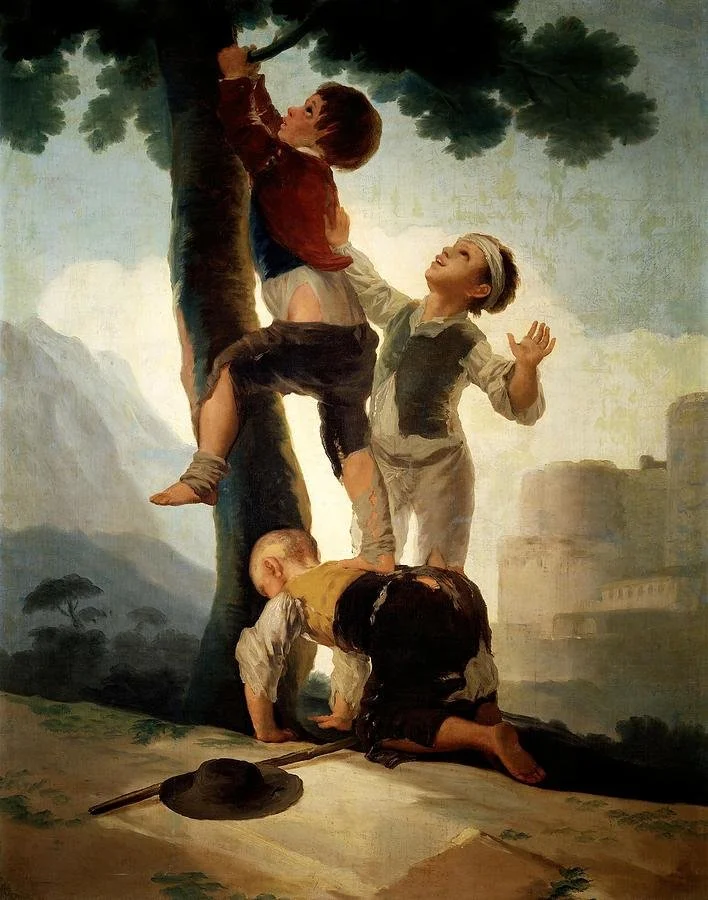
Boys Climbing a Tree by Francisco de Goya (oil on canvas, 1792)
Why personal responsibility is the first step toward deep comprehension and Christian application
Today my son and I read the first act of a drama called “The Coyote Song,” by Karen Wooster and Rebecca Fitchner. It is an adaptation of a traditional Native American tale, about a coyote that cannot remember a song, no matter how hard he tries.
My son has a hard time remembering things. He changes the instructions he is given and confuses words. He doesn’t always understand simple instructions and he doesn’t ask questions when he should. He is very active and very intelligent, but he misses the mark on things like comprehending what he is reading. Although I am not a fan of mother’s who air-out their children’s shortcomings, I wanted to share the bit of wisdom that glimmered like a train through our reading session, just when I had been struggling with how to help him climb over those hurdles that have slowed him down all month.
It was about the coyote and his encounter with the gopher. The coyote is singing along as he is walking a path in the forest, when suddenly he stumbles into a gopher’s hole and angrily accuses him of making the path nothing but holes and dusty traps. The gopher replies by telling him that he was not watching where he was going, hence…
My son understood that the coyote was not glad to have met gopher only because he blamed him for making holes and traps.
Yesterday, my son made plans, on his own, to make a visit to my mother and have my mother-in-law call in from long-distance. He asked us for permission to visit my mother but we didn’t confirm and thus, he leaned on his own understanding and went ahead with making the call to my mother in law for the plan. Suffice to say, it was a no-go, because he had home school the next day, because he had math to do with dad that evening, and because my mother was not advised. When he spoke to my mother-in-law to cancel, she asked why and he told her that my husband didn’t let him go.
He stepped in a gopher hole. He didn’t watch where he was going. He blamed his dad for it.
The glimmering train arrived when he responded to a question I asked him about the text. I asked, Why is it wrong to blame others for our own carelessness?
He knew what I was referring to. Although the question was meant to guide his comprehension into an appreciative level, he understood and said so wisely the following.
He said that the coyote shouldn’t have blamed the gopher for his falling into a hole because God made the gopher to be one to make holes in the ground, and that in the same manner, God made his daddy to be his parent; thus, he (my son) shouldn’t blame my husband for his plans not falling through.
I was so happy to hear him say what he did. It was application, at it’s best, as my husband put it. It was also a sweet reminder to me that as we home school our son, despite the occasional frustration we may experience in the process when he is struggling with developing his reading comprehension, it is good to see that he indeed looks for himself in every story that he reads. He seeks to identify what best relates to him. He is teachable and is thinking critically, and in a big picture world, that goes a long way. ❧
Originally published on 10-25-2013
❧ AT THE TABLE SOCRATICS ❧
-
Defining the Core Idea: In the drama The Coyote Song, why did Coyote get angry at Gopher after walking down the forest path?
Identifying the Contrast: How did the son's initial reaction of blaming his father contrast with what he realized after reading and discussing the story?
-
Analyzing the Argument: How does the mother connect Coyote falling into the gopher hole with her son making unauthorized family plans and then blaming his father?
Finding the Cause: What caused the mother to move from feeling discouraged about her son's comprehension difficulties to feeling joyful about his learning progress?
-
Evaluating the Thesis: The son concluded that just as God designed Gopher to dig holes, God appointed his father as his parent and authority. How does this simple realization challenge the broader human inclination toward blame-shifting when confronted with boundaries?
Synthesizing & Applying: How can home educators use story, fable, and literature to nurture moral reflection and self-correction in children without resorting to harshness or public criticism?