
Faspa As Worship: A Living Etymology
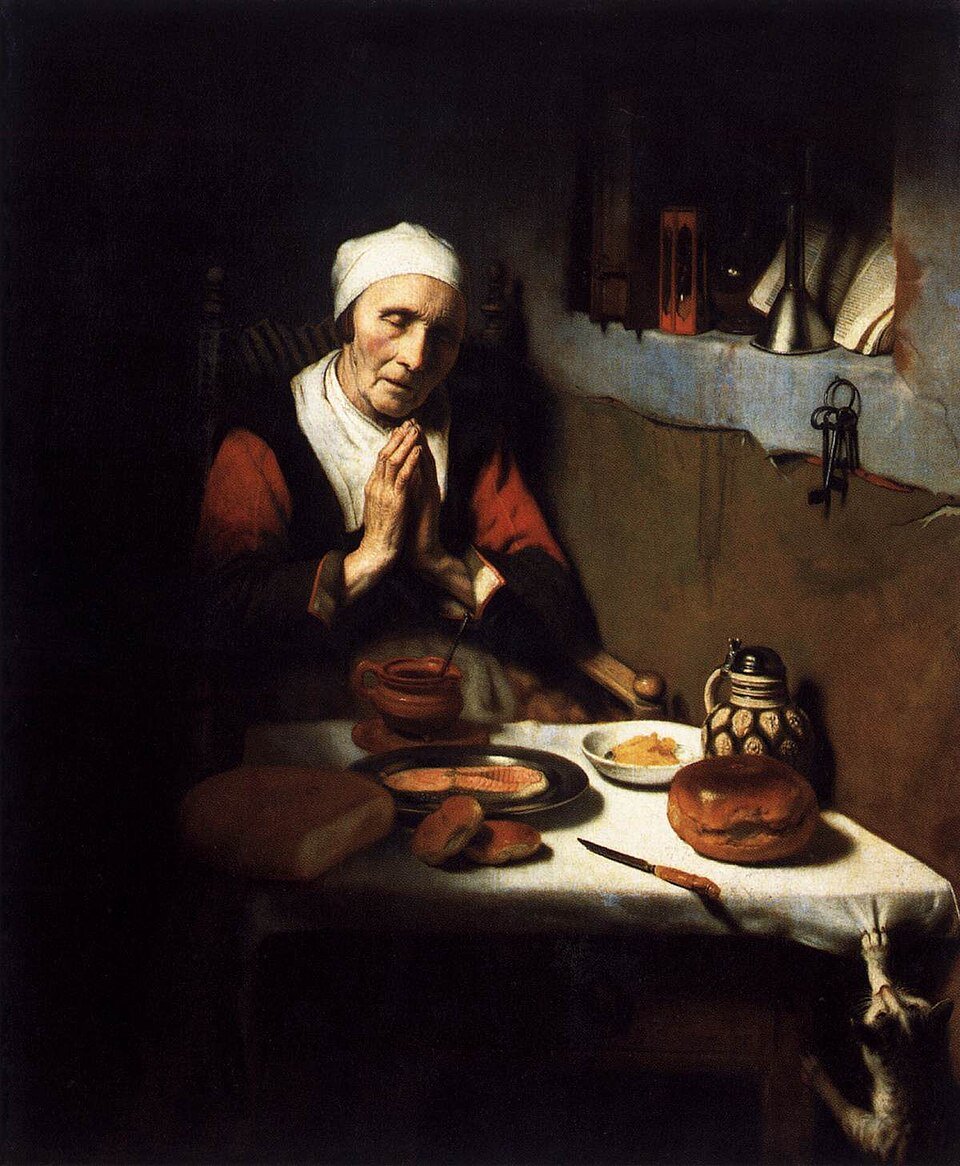
The Prayer Without End by Nicolaes Maes (oil on canvas, 1656)
It all began with pluma mos. My recipe card detailed a sweet cold soup made with prunes, raisins, and spices.
I’ve eaten it many times over the years when I was with extended family for Christmas, but this year I asked my father, “What is the word mos? What language is it? Russian or German?”
He replied it was spelled the same way on his recipe card. He had copied it from his mother who had copied it from hers. “It’s Plattdeutsch, Low German,” the language he grew up with, commonly known as Plautdietsch.
The internet was little help at first. I reached out to a cousin. Her recipe showed the same spelling as well. Like me, we had eaten mos for years but had never learned a definition for the word itself.
In the 1870s, my mother and my father’s families immigrated from Holland to the Black Sea region of Russia. Through her colonizing agents, Catherine the Great had promised religious freedom, freedom in trade, and 170 acres of land to each family. But Russia also needed soldiers, and when change came, these families moved to Nebraska, settling as farmers and building God-fearing communities in the Mennonite tradition. (I was able to borrow a 1975 centennial edition of the account and records from the Henderson Centennial Committee edited by Stanley E. Voth). Heisers, Rempels, Bergens, Hiebners, Epps, and Friesens. Their farm town of Henderson, Nebraska, was the careful planning of an expedition of men from the Alexanderwohl Mennonite colony in the summer of 1874. The group of twelve toured available land from southern Canada to the Dakotas, Nebraska, and Kansas.
When the twelve returned to Russia, General Todtleben, a representative from the Czar, spoke in their group meeting and urged the Mennonites not to leave, promising to remove the military service requirement. Todtleben did his best and spoke about all that the people had built and how they should stay. But it did not work. The people voted unanimously to go.
When I was young, my family drove long hours from Mississippi to visit grandparents, aunts, uncles, and cousins in the summer and at Christmas. It seemed as if everyone I met was a cousin of a cousin. My most distinct memories in Henderson center around family farms and irrigation ditches. I can hear the low voice of my father’s father chatting with me and my sister as he looked along the corn rows and let us play. Black earth, cold well water, and catching frogs in the heat of the summer sun. We climbed trees, played in the hayloft, chased the barn cats, cuddled their kittens, and investigated the still-working outhouse.
But many of my memories also center around food, especially a meal called faspa. I heard the word on occasion at home when I was young. My parents would use it to describe a meal that required no cooking. Like mos, I didn’t know where the word came from or why it was used. All I really knew was that it was the lighter meal at the end of Christmas day or at any family reunion or gathering often served at 5 pm. Pluma mos or cherry mos was served cold alongside zwieback, jams, summer sausage, salads, and verenike dumplings.
I hunted for what must be a niche meaning for the word mos, but I also asked my parents and cousins what faspa was to them. Both generations described how every single week after Sunday naps, church families joined each other for a visit. Food preparation and chores had been completed on Saturday. Children played, adults chatted, and a meal was shared. But faspa wasn’t just any meal. It wasn’t meant to be a huge preparation. It was a light supper, often cold, often snacks, and it seemed to be confined to families within the same church in a farming town with only three churches. It echoed of the Sabbath.
The tradition of faspa, however, extends far past a single region in the United States to many Mennonite communities throughout North America and Europe. In the 1870s, both my mother’s and my father’s families settled in Nebraska, and my great-uncles settled in Saskatoon, Saskatchewan.
In Manitoba, Doris Penner writes for The Carillon that in the Russian Mennonite tradition, faspa, sometimes vaspa, was originally a mid-afternoon meal for farm laborers to tide them over from lunch to supper. Since the work day ended with last light at sundown, the men needed to eat three or four hours after the noon meal. In the podcast Tales from the Mennonite Heritage Archives (Canada), Dan Dyck describes a homegrown, handmade, uncomplicated meal of zwiebach, farm cheese, ham, cheese curds, homemade pickles, and jam.
In the same communities, Penner says that faspa was served on Sunday as well. As a true Sabbath, no house or farm work was done so faspa became a substantial full evening meal that required no cooking. She describes what my family experienced and details more of the repast where she lived. It was “a time to invite friends and relatives over to exchange news.”
And then I saw it. In describing specific foods, Penner also listed the same cold fruit soup that I knew with a slight spelling difference: “Moos (cold fruit soup) was sometimes served at a company faspa. In winter it would be based on dried fruits, but in spring rhubarb moos was a specialty.”
Mos or moos. Contemporary German dictionaries define moos as moss or dough, the slang word for money, but its history truly belongs with the original Mennonite colonies and the few linguists trying to preserve a dying language and dying customs. A Canadian Plautdietsch dictionary provides a few more hints. Moos can also mean sauce or pudding in words like aupelmooss or applesauce. It is used interchangeably in Plautdietsch in phrasing like “supp ooda moos,” soup or moos.
In Mennonite Food and Folkways, Norma Jost Voth from Hillsboro, Kansas, interviewed sixty Mennonite women who had grown up in Russia. Mary Janzen of Newton, Kansas, recalls moos as part of Christmas dinner. She describes the meal as “plümemoos (a sweet plum compote), baked ham, cucumber and beet pickles, and two kinds of bread.”
In my light-hearted search for moos, I had also found a treasure in recounting the intentionality of Sunday faspa. A distinctly Mennonite word derived from the German word fesped or vesper, it is familiar to many as an evening worship or prayer service in a number of church traditions. That meaning is what resonates most with me—that a Christ-following culture of people, any people, chose to maintain a tradition of fellowship within extended family and church.
As regular as Sunday morning services, a weekly gathering that became a tradition of centuries holds a strength I haven’t witnessed in my lifetime in any church culture. It was a time set apart for every Mennonite. Yes, I view my heritage with gratitude, but I also see that faspa was a commitment, a self-less one, and a long obedience to Exodus 20:8. As God set apart this day of rest, so did the Mennonites.
It wasn’t optional. It wasn’t the oft-used word community. It wasn’t a church program or an insular member requirement. And to me, it is worship. A peoples’ history is my history. I am not in a Mennonite congregation or community, but my heart is indeed with my forebears in this intention, this endeavor to be unified, to be present, to be Jesus to one another. ❧